Rosen Commonwealth
Overview
.png) 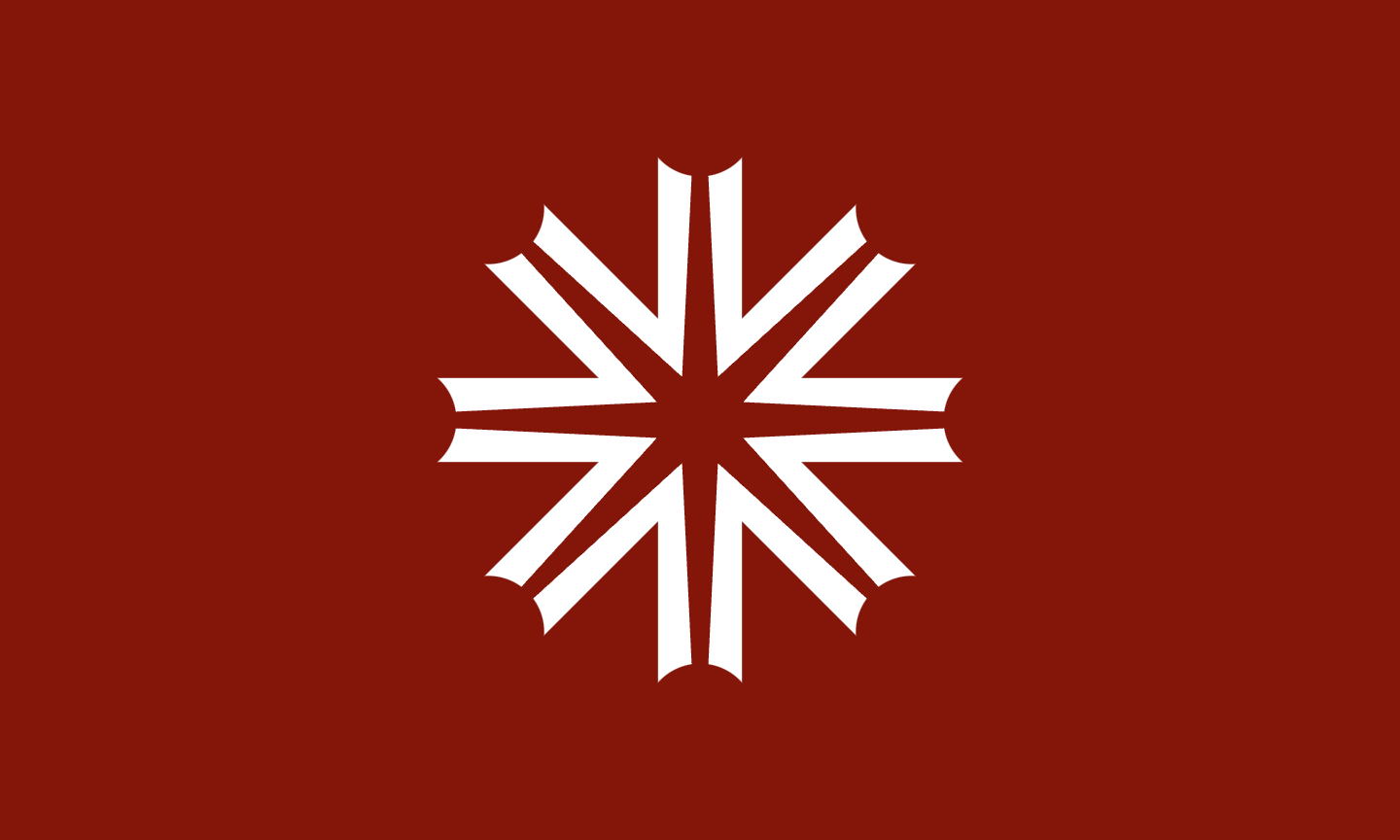 1) National Flag of the Rosen Commonwealth 2) Civil and War Flag of the Rosen Commonwealth |
|---|
| Motto: “Unitas, Democratia, Felicitas” |
| Anthem: “Martius Liberatorum” |
| Capital and largest city: São Cedillo |
| Official languages: - Simplified Sennan - Southern Sennan - Hanan - Velese - Sanan - Tuvayan - Standard Helsayan - Eilese Recognized minority languages: - Northern Helsayan - Kelhese - Mayolic-Kayan - Feveik - Veytuan |
| Demonym: Rosen |
| Ethnic groups: - Sennan: 35.8% - Hanan: 19.3% - Velese: 15.5% - Sanan: 7.1% - Tuvayan: 6.8% - Helsayan: 6.1% - Eilese: 4.9% - Other: 13.0% |
| Government: Non-partisan socialist federal directorial republic - Secretary-General: Roberto Araújo-Thommason - Deputy Secretary-General: Adelaide Douglas - President of the Senate: Lubomir Rydzewski - Chief Justice: Benjamin Haering |
| Legislature: Senate (unicameral) |
| Formation: - First Constitution: 18 June 1982 - Second Constitution: 3 November 1990 |
| Area: |
| Population: ▲ 395 million (4th) |
| GDP (nominal): - Total: 19.49 trilion AC - Per capita: 49,341 AC |
| IID: 0.91 (Very High (1st)) |
| HDI: 0.97 (Very High (1st)) |
| Currency: Ayan Credit (AC) |
| Traffic side: Right |
| Internet TLD: .rc |
| The Rosen Commonwealth is a country primarily located in East Aya. It is a non-partisan socialist federal republic comprising 23 republics. It shares land and maritime borders with several other countries. With a population of 295 million people (2050 Census), the Rosen Commonwealth is the fourth most populous country in the world. Its principal financial center, capital, and most populous city is São Cedillo. The federal (commonwealth) government is a republic and socialist democracy with executive, legislative, and judicial branches. A high degree of autonomy is devolved with the Commonwealth's first-level subdivisions, republics. |
| Modern Rosen territory was first settled with the migration of Paleo-East Ayans. After a long period of colonization (1606-1791) by the Sayese Empire, ideological and ethnic tensions between the Sayese Imperial Crown led to the Winter Revolution (1792) and the establishment of the Rosen Federal Union. The RFU expanded westward over the 1800s, leading to the Southwestern Wars in the 1850s. Election disputes after the 1858 presidential race and lasting political divisions led to the First Rosen Civil War (1858-1871), which toppled the federal unionist government and established a liberal democracy. Through the late 1800s and early 1900s, the Rosen Republic established itself as a great power and a strong economy. The Rosen Republic sided with the Sayan Coalition during the World War (1901-1913). The Cold War (1918-1976) between the Rosen Republic and the newly-formed Sayan Union caused a sharp increase in wealth inequality, political upheaval, and civil unrest, leading to the Second Rosen Civil War (1976-1983). Socialist Party forces won against the Democratic-Nationalist Alliance, establishing the First Rosen Commonwealth in 1984. The new commonwealth, sanctioned heavily by the outside world, underwent a series of crises that led to a nuclear weapons exchange with the countries of West Aya and the Sayan Union. After the close of the Nuclear Crisis (1989), the Rosen Commonwealth underwent a series of reforms, forming the Second Rosen Commonwealth. The Commonwealth is now experiencing the Rosen Golden Age (2019+), establishing itself as a global superpower. |
| The Rosen Commonwealth is one of the world’s most developed countries and ranks among the highest globally in terms of productivity, innovation, human rights, labor rights, and education. The Rosen economy, though socialistic and relatively unusual, is the largest in the world nominally, accounting for nearly a quarter of the world’s GDP. The Rosen Commonwealth is a founding member of CADO, the International Union, the World Bank, and the Trans-Ayan Dialogue, as well as a permanent member of the International Security Directory. |
History
Colonial Period and the Winter Revolution
The Sayan Empire established colonies in East Aya in 1606 in an attempt to fund its war against the Kingdom of Andolina. Both the colonists and the indigenous peoples (known as the Rosens) allied to expel the Sayese from Aya.
Establishment of the RFU, Running West, and Urbanization
The Rosen Federal Union, formed by the Congress of Wallaceburg, was deeply authoritarian (although stable) and consolidated power within the “Red Council,” led first by Cecilio Ramos. Industrial modernization, internal stability, and other factors led to the beginning of cities in East Aya.
Modernization and pressure from influential millionaires and philanthropists throughout the 1820s led to wider democratization and a weaker federal government; extensive power (especially the economic kind) was devolved to republics in a system that would become synonymous with Rosen governance. The Charter of the "Second System" entered effect in 1829, introducing universal suffrage to the Union whilst banning poll taxes and literacy tests.
During the 1850s, under the administration of Hermínio Fidalgo, the RFU encountered the Yeik Empire in the far southwest of East Aya. Largely to please agricultural oligarchs who had business interests in the region, Fidalgo started the Southwestern Wars to exterminate the Yeiks and take control of the East Ayan Southwest.
By 1857, Rosen forces had lost the war, leading to a loss of confidence in the central government and widespread revolts. The RFU split into three major factions: the Socialists, who wanted to establish a socialist state, the Confederalists, who wanted to devolve more power to the republics, and the Restorationists, or Reds, who wanted to further the power of the Federal Union's president, Joao Fidalgo.
First Rosen Civil War and the Establishment of the Rosen Republic
The Reds had abundant foreign support but were chronically disorganized, and socialists made up much of the military’s officer corps, leading to the brutal 13-year-long Rosen Civil War. After Armando Ribeiro's expulsion of “radicals” from the Confederalist army, the Confederalists (allied with a social democratic socialist splinter faction) gained significant ground, and the Socialists and Reds surrendered in 1871 at the Concordance of São Lola. The Rosen Republic was declared shortly afterward, led by Vincenzo Salera. The first national elections were held in 1875, marking the beginning of full democracy in East Aya.
Economic Boom, Prosperity, and the World War
General Ribeiro initially posed himself to lead a military-backed provisional authority while the Union rebuilt. However, industrial representatives in the former Rosen Federal Assembly distrusted a potential junta and pushed Maurycy Basara to lead a constitutional committee. In March 1876, Basara was put in place with the compromise that Ribeiro would be commander-in-chief, a position that Basara appeared likely to hold.
The New Articles laid out temporary rights to Rosens like freedom of speech, press, assembly, and religion, but lacked an enforcement mechanism as a government didn't yet exist to guarantee them. The New Articles were deemed weak and rolled into a larger constitution ratified by Basara and a provisional legislative assembly in October 1876.
Widespread economic liberalization and infrastructure growth under the Joaquim Neves-Coelho administration (1877-1884) led to an economic boom and the rapid growth of the country's industrial and financial sectors. The Rosen middle class grew exponentially as industrialism enabled Rosens to obtain higher-quality jobs in new areas of the economy.
The highly prosperous Leon Podolak administration aimed to take a neutral stance toward the World War, as business relations with both sides were too precious to risk entering the conflict. Despite this, Podolak signed the Sayan-Rosen Treaty of Friendship in 1912 (toward the end of his tenure), which pledged minor material and financial support to the Sayan Empire. Despite this, Saya at that point had completely overrun Allairist Vaua, meaning the Rosen Republic was largely excluded from post-war negotiations (a factor of the following Cold War).
In 1914, as the First Sayan Civil War began, the Rosen government, fueled by pro-capitalist outcries from upper-class members of society, directly intervened in the conflict on the side of the Nationalist Party. As the war dragged on into the late 1910s, public support for the war fell dramatically and Bruno Vaz-Rocha was elected to end Rosen involvement in the war in 1917.
Rosen-Sayan Tensions and the Beginning of the Cold War
Once the Sayan Union was established in 1918, many in Rosen government believed that the ideological differences between the two countries meant that the Rosen Republic was obligated to contain the spread of global communism through military intervention across the world.
In 1921, a navy military junta led by Admiral Wilhelm Sosnowski took control of the Rosen Republic's internal functions, leading to a brief economic crisis in which foreign investors fled the country en masse, fearing a wider revolution. Sosnowski's government led to a crackdown on internal corruption and a rebirth of the stagnating Rosen economy, but greatly accelerated the Rosen Republic's entry into the Cold War.
While the Rosen Republic and the Sayan Union never directly fought, both countries intervened in hundreds of proxy wars of varying size across the world. Tensions between the two countries were exacerbated by the first Rosen nuclear bomb test in 1944 and a following Sayan bomb in 1947. Domestically, the Rosen Republic's economy continued to expand, as did its population and cities.
The ethnic equality movement, spurred by increasing immigration to the Rosen Republic, began to take shape in the 1950s under the leadership of Eizo Ishikura and Matthew Crowe. In addition, the Rosen Aerospace Research Agency, under the administration of Sebastian Batista-Delchario, led to the exploration of space and the success of the Rosen Republic in the "Space Race".
Economic Stagnation, Poverty, and Wealth Inequality
Rapid growth of the Sayan economy, combined with domestic corruption, the Rosen Republic's ballooning national debt and mismanagement of funds led to a series of economic crises from 1959-1968 that highlighted underlying social issues and corruption in the Republic.
Internationally, the Rosen Republic still intervened in multiple high-profile conflicts in the Arawad and West Aya. While some politicians in the Sayan Union advocated for detente and "peaceful cross-ideological coexistence" with the Rosen Republic, overtures of friendship were met with political condemnation spurred forward by rampant anti-communist paranoia in the Republic.
As a result of political and social unrest, in 1965, the "Kuligites", under Ricardo Kulig, led the "Kuligite Restoration", aiming to reform the Rosen economy and political system in order to reverse the chain of events taking place in the country. While the Kuligites were successful in establishing the Third Rosen Republic, the Rosen economy was once again in crisis due to the upheaval and revolts had begun in major cities across the Republic.
In 1972, the São Lola Treaty Organization (SLTO), the world's foremost anti-communist security organization, collapsed due to a lack of Rosen materiel support and continued alienation from the isolationist wing of the Kuligites. At that point, the Sayan Union, experiencing crippling political and economic issues itself, declared itself the "winner of the Cold War.”
Second Rosen Civil War, Socialist Victory, and Establishment of the First Commonwealth
The Kuligite cross-party coalition finally collapsed in early 1974, signaling the end of Rosen unity and sparking the Second Rosen Civil War. Prominent socialists, such as Jorge Almeida and Hatsue Yuhara, led mass general strikes across the country that crippled the country's industrial output. In August 1974, the Rosen Armed Socialist Front (RASF) led revolts in São Lola, and declared the city a part of a new Rosen socialist state. In opposition, the Rosen Government coalesced once more to form the Democratic-Nationalist Alliance in 1975. The Second Rosen Civil War truly began on February 3rd, 1976, when the RASF confronted the Democratic-Nationalist Alliance in the city of Navarro.
Unrest within both sides meant leadership was weak and political action was inconsistent and sporadic. In 1979, Julian Rybicki led a self-coup d'etat and declared himself "Permanent General Secretary" for the duration of the conflict. The RASF, despite its internal problems, continued to win military victories in the West and forced Nationalist leadership to sign the Treaty of Navarro in 1983, which dissolved the Democratic-Nationalist Alliance and asserted total control of the newly formed Rosen Commonwealth over the former lands of the Rosen Republic.
The First Rosen Commonwealth, like the preceding RASF, was plagued by internal issues and civil unrest. Julian Rybicki refused to step down from his position once the war had ended, which meant the country effectively operated as a one-party authoritarian state.
In 1984, the Commonwealth began the New Society Economic Policy (NSEP), which redistributed agricultural and industrial land, formed government-owned corporations to oversee the economy, and forcefully acquired major Rosen corporations like Hafiz Industries, Ayan Electric, and Iseva Corporation. NSEP, spearheaded by members of Rybicki's cult of personality, was a massive failure and led to food shortages, poverty, and corruption within the Commonwealth's government. Further crises, like the attempted navy coup in 1985, the Wallaceburg attacks in 1986, and the death of Julian Rybicki in 1987 further worsened the First Commonwealth's situation.
With Rybicki gone, tensions between the Commonwealth and the Sayan Union, (which were cool at best during Rybicki's tenure), skyrocketed over the fate of the SLTO countries and other territorial and ideological disputes.
The Nuclear Crisis, Fall of the Sayan Union, and Victory
The Nuclear Crisis was sparked by the fall of the Rosen Republic and the continued tensions between East Aya and the rapidly deteriorating Sayan Union. With both countries led by disorganized and frantic governments, a crisis was expected by many.
The First Rosen Commonwealth heavily disputed West Ayan claims to the Bernard Sea, which was rich in mineral and petroleum deposits. In response, many West Ayan countries and the Sayan Union formed the International Coalition for Stable Governance in East Aya (ICOSGEA) to economically and politically pressure the Rosen Commonwealth into relinquishing its claim to the Bernard Sea. Tensions came to a climax on the 2nd of November, 1989, when miscommunications between ICOSGEA military forces resulted in active conflict over the Bernard Sea. Sayan ICBMs, mistakenly believing nuclear war had already begun, launched without orders.
The Nuclear Crisis was the single greatest loss of human life in history, and the Rosen Commonwealth lost 102 million civilians during the conflict. While the heroism of the Rosen Commonwealth's Civil Defense Service and the country's expansive Rosen Republic-era ballistic missile defense systems spared many of the Commonwealth's largest cities from total destruction, the Commonwealth was effectively in a state of confused anarchy, governed primarily by warlords made up of disaffected members of the collapsed Rosen Commonwealth Armed Forces (RCAF).
Establishment of the Second Commonwealth and Contemporary History
"Disgraced" leftists like Deng Liang, Hatsue Yuhara, Cora Cavaleri, and others convened several times in January 1990, declaring the Transitory Commonwealth in the absence of a central government. With assistance from an international IU peacekeeping force, the largest warlords were arrested and tried before a military tribunal, with the trials officially ending as late as 2019.
The Executive Committee of the Transitory Commonwealth fully conceived the Second Commonwealth Constitution in November 1990, which established the Second Rosen Commonwealth on 3 November 1990.
The early Rosen Commonwealth was primarily occupied with the reconstruction of the country following the Nuclear Crisis. Under the leadership of the first and second Secretariat-Directories, the infrastructure and military of the Rosen Commonwealth was rebuilt extensively using new architectural and engineering techniques.
Internationally, the Rosen Commonwealth was tasked with rebuilding its foreign relations, which it did through the establishment of relations with the State of Saya (1999) and the West Ayan Republic (2001).
Under the secretary-generalships of Andreas Nielsen and...
Geography
The Rosen Commonwealth is exceedingly biodiverse, and hosts a reasonably wide variety of climates and habitats. It is the world's second-largest country, behind the West Ayan Republic. Stretching from about 35°S to 82°S, the Rosen Commonwealth lies entirely in the southern hemisphere and occupies the entire southern portion of East Aya.
The northern parts of the Commonwealth, especially those bordering the Namayan Sea, are incredibly hot and dry and are considered deserts. The Inde-Yomile Belt refers to the stretch of desert and steppe that characterizes this region. Moving southward, the interior of the Commonwealth consists of relatively wet and expansive humid forests, broken up occasionally by plains used primarily for farming and industry. The interior is also rather high, sitting at an average of 600 meters above sea level. Many rivers originate from seasonal lakes and ponds, despite the fact that the interior has a very brief dry season from December to February.
The eastern coast, often called the Seaboard, was first settled by West Ayans and is particularly inviting to agriculture and urbanization, consisting of coastal lowlands with extremely fertile soil. The northeast is hot and humid, with frequent thunderstorms in the summer and mild winters. Major crops grown included tobacco and cotton, which is, albeit at a much smaller scale, still grown today. The Mideast rapidly drops in temperature as the Sennan plain ends and the Tuyei hills take its place. The Mideast is densely wooded and experiences almost nonstop rain year-round. The temperature range is narrow and both summers and winters are mild; despite the rain, much of the Seaboard's population lives in the Mideast. Further south, the elevation drops, along with the temperature, with milder summers and longer winters.
The western side of the Commonwealth, called the Leeward Coast, is significantly dryer, with hot summers and wild winters. Like the Seaboard, the Leeward Coast gets colder as it moves southward, but wider coastal plains mean the Leeward coast is much closer to sea level. The Leeward Coast is more rural and is known for vineyards and the energy industry; the region suffers from frequent droughts and even wildfires, especially in the summer.
The southern third of the Commonwealth is extremely cold and is largely uninhabited. Fishing is common, and the region is sparsely populated except for small hamlets and military bases.
Government and Politics
The Rosen Commonwealth is a federal directorial republic comprised of 23 republics. It is a hybrid representative/direct democracy in which citizens elect representatives to the Senate and vote on laws directly. The Second Commonwealth Constitution is the supreme legal document, guaranteeing fundamental rights to Commonwealth citizens and establishing the responsibilities of the commonwealth and subdivisional governments.
National Government
Comprising three branches, headquartered in São Cedillo and Navarro, the Commonwealth government is the national government of the Rosen Commonwealth.
The Senate, a unicameral legislature, makes federal law, manages the economy and trade, declares war, controls the government’s budget, and elects members of the Secretariat. The Senate has 138 members, composed of two pairs of a man and a woman from each republic, elected for four-year terms.
The Secretariat makes up the executive branch of the government. It primarily consists of the Secretariat-Directory, a council of nine senators known as Secretaries who the Senate elects for four-year terms. The Secretariat-Directory also elects the position of Secretary-General, who functions as a (largely ceremonial) head of state and government who rubber-stamps the Secretariat-Directory’s decisions. The Secretary-General holds eight-year terms, and can serve a maximum of two terms.
The larger cabinet, composed of the Secretariat-Directory and various appointed officials, advises the Secretariat-Directory. It is led by the Vice-Chair of the Secretariat-Directory.
The Supreme Judiciary consists of the Supreme Court and the Court of Appeals. The Supreme Court interprets laws and overturns them if found to be unconstitutional. The Supreme Court has 13 members who serve 20-year terms. When a seat is vacant, a new judge is appointed by the Secretariat-Directory, with the approval of the Senate and the current Justices.
Political Subdivisions
In the federal Commonwealth system, sovereign powers are shared between two levels of elected government: national and republican. Provincial and municipal governments also represent the people within republics. Republics are divided into provinces and municipalities. Republics receive considerable autonomy and representation within the national government, meaning many Rosen people identify more with their republics than with the Commonwealth itself.
Foreign Relations
The Rosen Commonwealth is a member of a large variety of intergovernmental organizations. It is a founding member of the International Union and the World Bank and a member of the Trans-Ayan Dialogue and the International Security Directory. It was a member of the G5 until the Veytuan War. The Commonwealth holds key allies in many parts of the global south, leading the Collective Action Defense Organization. The Rosen Commonwealth has diplomatic missions to every country in the world, and nearly every country has embassies and consulates in the Commonwealth.
The Rosen Commonwealth is the economic and military rival of the world’s second-largest economy, the West Ayan Republic. Ties with the West Ayan Republic have steadily deteriorated since relations were established in 2001. The Commonwealth uniquely describes itself as “anti-imperialist,” though other countries, especially the People’s Republic of Veytu, often reject this claim.
Military
The Secretariat-Directory appoints the leaders of the Rosen Commonwealth Armed Forces, and the Secretary-General functions as commander-in-chief of the entire military. The Department of Defense is headquartered in Żole, administering every branch of the armed forces, excluding the Space Force, which the Rosen Commonwealth Aerospace Operations Department operates.
The Rosen Commonwealth spends relatively little on its military, accounting for 2.2% of the country’s GDP. The Rosen Commonwealth has 55% of the world’s nuclear weapons, followed by the West Ayan Republic and the State of Saya. The military operates 43 bases and facilities abroad, mostly in other CADO countries.
Economy
The Rosen Commonwealth’s economy has been the largest globally since 2004. The 2052 gross domestic product (GDP) of AC28 trillion was the highest globally, constituting 36% of the global economy. Over the last 50 years, the GDP of the Rosen Commonwealth has grown an extraordinary 157.9%, catalyzed by the emergence of the internet, nuclear fusion, and artificial intelligence.
Article 13 of the Second Commonwealth Constitution officially structures the Rosen Commonwealth as a moneyless, socialist, and economically utopian society. During the late 2000s, when the Rosen Commonwealth’s economy exploded in value and size, Article 13 was largely disregarded in favor of a "reformed almeidaist socialist economy", permitting currency and economic competition in exchange for large social programs and socialist economics on the local level.
The currency of the Rosen Commonwealth is the Ayan Credit (AC). All CADO countries and several World Bank countries use the AC as reserve currencies, backed by the Commonwealth’s globally dominant economy and large treasury. In some countries, it functions as a de facto currency. The Commonwealth has free trade agreements with relatively few countries, especially when compared to the economic alliances of the West Ayan Republic or Saya. While the Commonwealth has reached a post-industrial level of development, it remains an industrial power. As of 2052, the Rosen Commonwealth is the second-largest manufacturing country after Saya.
São Cedillo is the principal financial center of East Aya and the global south. The São Cedillo Stock Exchange and S-Fico, located in São Cedillo, are the world’s two largest stock exchanges by market capitalization and trade volume. The Rosen Commonwealth is at or near the forefront of technological advancement and innovation in many economic fields, especially in artificial intelligence, electronics, pharmaceuticals, and medical, aerospace, and military equipment. The country’s economy is fueled by abundant natural resources, global cooperation, well-developed infrastructure, and high productivity.
While about 65% of the Rosen Commonwealth's GDP is generated by government-owned corporations, the existence and operation of domestic and foreign large corporations in the Commonwealth is permitted, although strongly regulated. Corporations such as Ayan Electric, Standard Electronics, HOSMAX, ARC, and Forza are examples of large (nominally) privately-owed companies in the Rosen Commonwealth.
Wealth in the Rosen Commonwealth is very distributed; high taxation largely prevents high degrees of income inequality. Housing is deemed a basic human right in the Rosen Commonwealth (guaranteed by article 2 of the constitution), therefore no citizens are ever considered homeless or unsheltered. Food is also an inalienable right and is provided for free in most suburban and urban areas. While Rosens do live in various levels of luxury, no Rosen is ever considered impoverished.
Evidently, the Rosen Commonwealth’s welfare provisions are considered the best on Avaya. The Commonwealth’s welfare model is distinguished from other types of welfare states by its emphasis on maximizing labor force participation, promoting gender equality, egalitarian and extensive benefit levels, the large magnitude of income redistribution, and liberal use of the expansionary fiscal policy.
Science and Technology
Laser Bay 2 of Yoshinaga National Fusion Facility

The Rosen Commonwealth has been a leader in technological innovation since the early 90s, establishing technologies like commercial supersonic aircraft, nuclear weapons, pharmaceuticals, space travel, artificial intelligence, and fusion energy. In the early 20th century, factory electrification, the introduction of the assembly line, and other labor-saving techniques created the first mass production systems. The Rosen Commonwealth dominates the AI field and has maintained a large space program since 2008. The Commonwealth has long-term habitats on Luna, such as Libertas Lunar Base, and has plans for crewed missions to the asteroid belt and Jupiter’s moons.
The Rosen Commonwealth created the first commercially operable nuclear fusion reactor in 2037, revolutionizing the production of renewable energy across the world. Since its invention, nuclear fusion has displaced natural gas and nuclear fission as the most used energy source in the Commonwealth.
Industry and Services

The Rosen Commonwealth has a large industrial capacity. It is home to some of the largest and most technologically advanced producers of motor vehicles, machine tools, steel and other metals, ships, chemical substances, and processed foods. The Rosen Commonwealth’s industrial sector makes up approximately 21% of its GDP. The country’s manufacturing output is the third highest in the world.
The Rosen Commonwealth’s service sector accounts for about 59.7% of its total economic output. Banking, retail, transportation, and telecommunications are all major industries, with companies such as Ayan Electric, Bennewitz Multisector, Mernissi Bank, and Standard Electronics listed as among the largest in the world.
Infrastructure
Transportation
H500 (left) and H450IC (right) high-speed ARC trains depart Karsten Central Station in Wallaceburg.
The Rosen Commonwealth has invested heavily in public transportation since the 2010s. Due to the comparative rarity of private vehicles in the Commonwealth, few people use automobiles as their primary means of transportation, instead opting for trains or metro networks for transportation.
Several private rail companies compete in the Rosen regional and local transportation markets; the largest among these are the Ayan Rail Corporation (ARC) and Northeastern Passenger Railways (NPR), both of which the federal government trades and buys shares in. ARC’s high-speed rail system is renowned for its safety and punctuality.
There are hundreds of airports and dozens of airlines in the Rosen Commonwealth. The Commonwealth is home to some of the busiest airports in the world, such as Figueroa International Airport and Pyotr International, both located in São Cedillo.
Energy
The Rosen Commonwealth receives just 21.6% of its energy from fossil fuels, and the largest source of the country’s energy comes from nuclear power (45.3%) (fissile and fusion), natural gas (19.9%), renewable sources (21.1%), and petroleum (13.7%). The Rosen Commonwealth ranks as the fifth-highest emitter of greenhouse gasses.
The Rosen Commonwealth invented commercially-viable nuclear fusion power in 2037 and it has made up a sizable portion of its energy mix since its invention. In 2053, roughly 33% of the Commonwealth's power came from nuclear fusion. According to the Senate Committee on Industry and Energy, 60% of the Rosen Commonwealth's power will come from fusion energy by 2070.
Communications
The Rosen Commonwealth, due to a lack of access to personal cellular devices, relies heavily on landline infrastructure for phone calls. Most private computers, especially those outside of urban centers rely on dial-up internet in order to access non-domestic traffic, and radio is still a major option to transmit information locally and nationally. Public phones are available across the Commonwealth free of charge. Televisions, especially in homes, have become increasingly common since the 2040s due to a push from the Eloá Correia-Serrano Directory to increase access to "modern communications infrastructure." The Commonwealth also operates an independent global positioning system, called Aquarius, which is used by many countries in Avaya; usage fees form a major source of revenue for the Commonwealth.
Demographics
Population
The Rosen Demographics Agency (RDA) reported a population of 395,981,102 residents in 2050, making the Rosen Commonwealth the fourth most populous country in the world. The RDA estimated a population of roughly 396.1-396.4 million residents in 2053. Rosen population growth has steadily leveled off since the 2030s, but it continues to sustain a growth rate much higher than many other highly developed countries due to immigration, cultural diversity, and the absence of the internet in popular culture.
Marriage is loosely defined in the Rosen Commonwealth and, as such, official statistics are few and far between. Many Rosens engage in platonic relationships involving children, some cohabitate without forming what could be defined as a marriage (or even a romantic relationship, for that matter), and some cultures do not accept marriage in the traditional sense at all.
It is estimated that between 55-60% of Rosens are in some kind of marital relationship. Divorce or practices similar to the aforementioned are uncommon; between 5-7% of Rosens were divorced.
The Rosen Commonwealth is extremely diverse. The identity "Rosen" is not linked to a specific "race" or ethnic group, and "Rosen" refers to anybody residing in the Rosen Commonwealth long-term. Rosen ethnic groups are largely composed of individual ethnically-mixed groups of a West Ayan and Native East Ayan groups. For example, Tuvayans descend from the Tuva group of Natives and the Vauans from West Aya. The largest ethnic groups are Sennans, Hanans, and Velese, with each composing about 35%, 19%, and 15% of all Rosens.
Language
Many different languages are spoken in the Rosen Commonwealth. Sennan is spoken widely in the northwestern republics, with Hanan, Velese, and Sanan also occupying similar roles in other parts of the Commonwealth. Generally, Sennan is used as an intermediary language in most parts of the country.
The Commonwealth government (especially during Eloá Correia-Serrano's tenure as Secretary-General) has promoted Rosen Median Language (RML) as a culturally-neutral successor to Sennan as an administrative language. RML is used primarily in the federal level of governance and has seen little use at the local level. However, RML has become more common in urban areas with high diversity, like São Cedillo and Navarro.
Immigration
The Rosen Commonwealth's immigrant population is the world's largest. The Commonwealth government enacted "sanctuary" laws immediately following the Nuclear Crisis until the 2020s to make immigration to the Commonwealth easier. Generally, Rosens are reasonably tolerant to immigration considering the preexisting diversity in the Commonwealth, though this differs based on location. In 2050, immigrants and Commonwealth-born children of immigrants composed around 19% of the overall population.
Religion
The Rosen Commonwealth emphasizes a strong division between religion and the state. Religious holidays may not become federal holidays, and there are few accommodations in place for religious practices in government. At the republican, provincial, and municipal level, however, Rosens of a variety of ethnic groups have proven to be exceedingly religious. Like marriage, the concept of religion is ill-defined, but the RDA reports that between 85-90% of Rosens "somewhat regularly" practice a religion of some kind, while 65-70% of Rosens "regularly" practice a religion.
There are hundreds of religions in the Rosen Commonwealth, with many of them animist or spiritist in nature. About 60% of religions practiced in the Commonwealth descend from East Ayan Native religions, with most being polytheistic and nature-centered. The arrival of West Ayan settlers in the 1600s brought Praianism and Demei, which quickly spread along the Western Rosen coast, creating the "Demei Corridor" that still exists today. Roughly 30% of Rosens adhere to a sect of Praianism, with most being ordinated members of Demei.
Urbanization
About 70% of Rosens live in urban areas, not including suburbs. Of the Rosen Commonwealth's 33 municipalities, 12 had populations above 6 million, with the "greater twelve" composing about 40% of the Rosen Commonwealth's population. The growth of the rail transit sector and the advent of commercial nuclear fusion have facilitated the rapid expansion of many urban areas, particularly in the Eastern Rosen Commonwealth.
The Rosen Commonwealth places a strong emphasis on urbanism and human-centered planning, making Rosen cities-despite their size-some of the most desirable places to live in the world. The automobile as a form of personal transportation has largely fallen out of favor, being replaced by well-planned public transit systems. For instance, São Cedillo's metro[1] is considered the largest in the world. It is larger than the next five urban metro systems combined, with three of the five also being in the Commonwealth. Certain cities, including São Cedillo, have had to institute immigration lottery systems for domestic migrants in order to combat overcrowding.
Major Cities in the Rosen Commonwealth
| Rank | Name | Population In Millions |
|---|---|---|
| 1 | São Cedillo | 21.3 |
| 2 | São Lola | 18.2 |
| 3 | Navarro | 12.9 |
| 4 | Wallaceburg | 11.7 |
| 5 | Szczezębie | 11.1 |
| 6 | Bełnowiec | 10.0 |
| 7 | Żole | 9.4 |
| 8 | Toukami | 8.5 |
| 9 | New Derry | 8.1 |
| 10 | Alismos | 7.2 |
Health
Universal access to healthcare in the Rosen Commonwealth is not explicitly guaranteed by the constitution. However, both the Transitory Commonwealth and the Supreme Judiciary and the Supreme Court have ruled that rights listed in the constitution like (access to food and water, housing, heating and cooling, etc.) imply universal access to healthcare. As such, the Rosen Commonwealth has one of the most robust healthcare systems in the world. All operations, from regular clinical evaluations to advanced surgeries, are completed at no charge to the user.
At the federal level, the Commonwealth's healthcare system is overseen by the Department of Health, Labor, and Welfare (DEPHEL), which is currently overseen by Secretary Selam Malomo.
Like most services, most administration of healthcare is devolved to the republics, with healthcare at the federal level mostly concerns medical education and broad health policy and directives.
Abortion in the Rosen Commonwealth is a common topic of debate; abortion and access to contraceptives are currently administered at the provincial and municipal levels, with negotiations underway to transfer responsibility to the republics. Abortions as a result of rape and incest are protected nationally due to federal legislation, but abortion as a form of birth control is highly controversial; no two republics share the same abortion policy.
Education
Education in the Rosen Commonwealth is entirely public and free, with charter and non-religious private schools banned. Homeschooling is permitted and sparsely controlled, but nonetheless rare. In general, the Rosen population is highly educated. Universal access to education coupled with high educational expectations, diverse and supportive classroom environments, and standardized education have made Rosens among the highest test scorers in the world.
Structure
Children are required to attend six years of lower grades (first through sixth grade), followed by a year-long break, and then five more years of upper grades (seventh through twelfth grade). After completion, one may attend a college for a standard degree and a university (typically following college) to obtain an advanced degree (or, with two to four more years of study), a doctorate in a particular field.
The education system in the Rosen Commonwealth has been gradually centralized since the 2030s. A requirement for higher-skilled labor, concerns over Rosen identity and civics, and the demands of the growing service industry necessitated stronger regulations on education at the federal level. Curriculums vary slightly depending on the republic, but examinations, advanced courses, and upper-level education is federally standardized.
Universities
Higher-level education is particularly standardized and consolidated, with almost every major collegiate institution a subsidiary of the National University, which governs standard degree education at the federal level. The NU is an organ of the Department of Education, so while specific class content can vary based on the republic the college is located in, standards and expectations are more or less the same across the Commonwealth due to the DEPEDU's involvement.
Not including adjacent bus, streetcar, light rail, and aerial tram systems. ↩︎